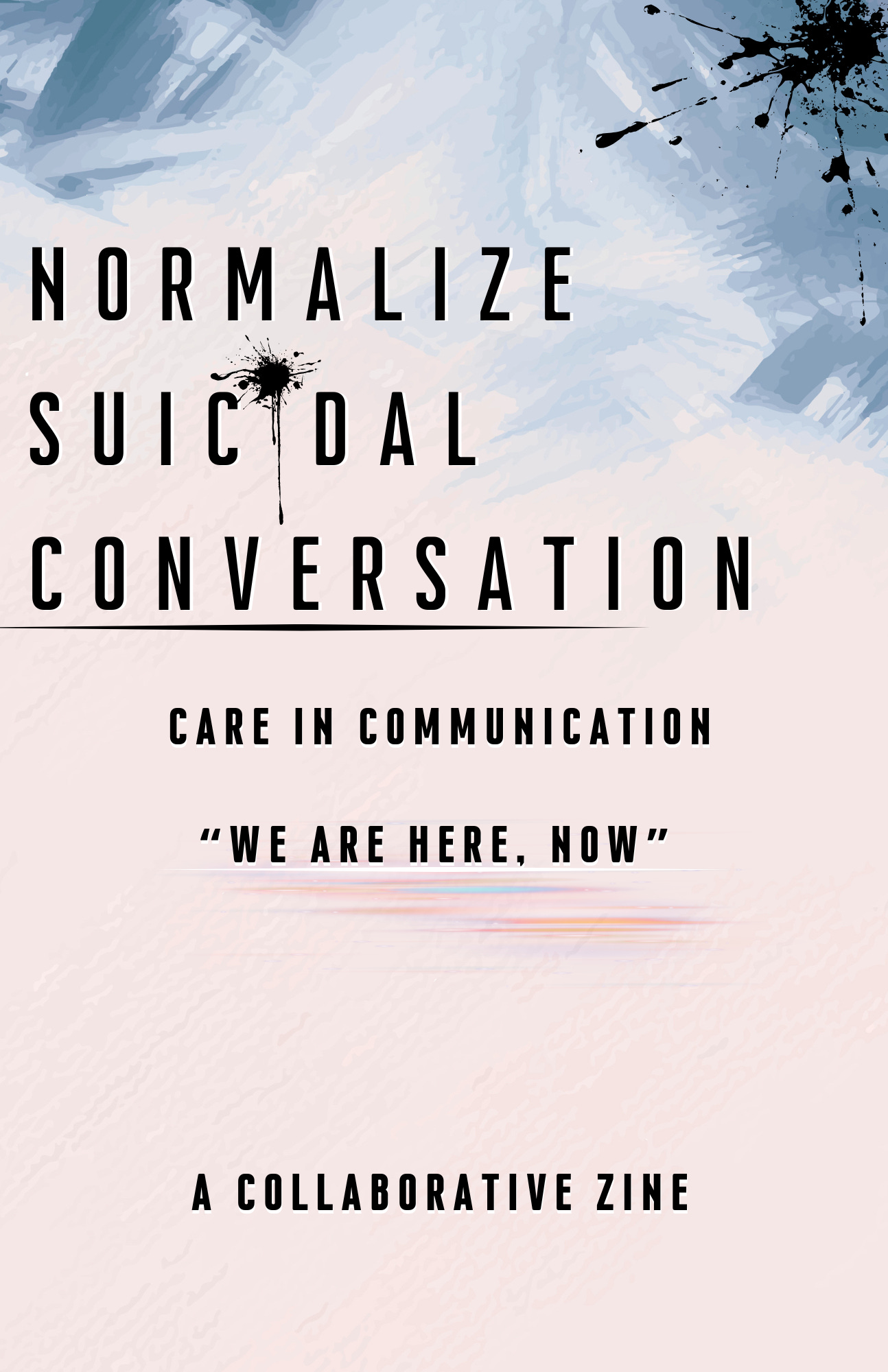
Normalizing Suicidal Conversations
Care in Communication - "We Are Here, Now"

This has been 4 moths, 7 contributors, and many uneasy days of crafting the patience for the way this came to be. This has been a truly enamoring experience to go through the connective healing process, especially for myself - as my own Ideations returned in full force this year - and they have less opportunity to hold back. Bringing these communications out into community involvement and learning how to support others in this time of need - especially creatively - is a blessing.
List of Contents:
Author’s Notes
Preface
Introduction
Causes of Ideation
a. The Culture
b. The Brain
c. The Burdens
d. Race and Gender : Perspectives from a “Post-Modern Mammy”
e. LGBTQ+ Identities
f. Etc. Etc. - Everything Impacts Us
Systemic Responses to Suicide / Why not commit?
a. Religious Implications
b. Medical Faculty Response
c. Social Responsibilities
d. Personal Responsibilities
Expressing Suicide
a. Suicide Has no Definition
b. Trusting Our Peers
c. Self-Harm is Relief
Normalizing Conversation
a. Baseline Listening
b. The Edge of Emotions
c. Ending Life on Our-Terms
d. Proof of Existence
Living Beyond Suicide
Acknowledgements
Written Practice/Handout
Resources
Contributors
Author’s Notes :
In the following document, the Author has chosen to use Capital “S” Suicide. This is to give it a ‘proper name’ without sublimating the verbiage into the commonly subtle or dismissive commonality. We want this word to stand out, we want it to mean something, to ourselves, as well as the reader. It belongs to us as a part of life that is no longer passive.
As this is an emotionally activating document, if at any time your own Ideation becomes too strong to feel - put this down. As this is an emotionally activating document, while it does speak to the distrust of certain mental-well-being services - if your Ideation becomes too strong at any point, reach out to those you do trust. We are here to begin shifting that proper understanding of care to those that we (as Suicidal people) determine are able to hear us out without entering a state of emergency. As a resource to begin that conversation - there is a written hand-out you can provide as a written message, text, or read out to a trusted individual to direct that conversation and unburden those Ideations. I trust that as you are able to pick up and begin interacting with this document, you have the emotional intelligence to determine your level of emotional need - and to respond appropriately.
Preface :
This document does not contain facts nor opinions on Suicide. It contains direct understanding of life from those within past and present Ideation. As most resources tend to come from authors that are responding to their own story/feelings, there is a lack of information pertaining to the direct experience of Suicide, if not filtered through novels or films. We are aiming to develop for others very certain clarity, while at the same the diverse origins of Ideation, as Suicide is not a simple topic with simple causes. These are not just ideas, these are griefs. This document is a practical application for your building of capacity to hear these Ideations. It is not an easy step to understand, or to be understood. This document provides that first point of contact to understanding Ideation by providing the broad variety and complexity in the whys of Suicide.
As this document goes through the lived-experience-truth-of-the-matter of Suicide, the language will not be softened. This will be an Activating series of to-the-point engagements, uncensored for the sake of honesty.
While the following text can seem to be a list of ‘bad news after bad news’, as Suicidal persons, our lives revolve around our mental and even physical emphasis of anticipating or experiencing ‘bad news after bad news’. There is no easy way into Ideation and no easy way out of Ideation - as we are in its activated experience - all we know is ‘bad news’. This text aims to resolve an understanding of our maneuvering of life within this lifestyle management while staying optimistic in that we are telling you the best (and worst) parts of us that need to be seen in order to live on a daily basis in order to outlive our Ideations.
Certain Authors and Editors have willingly chosen to stay anonymous or Alias their name for accreditation to this document. Reasons being: new to being an Author and using this as a step into the work, the fear of being completely vulnerable, and/or having the wrong person – especially medical professionals - seeing their name attached to such a document. This should affirm how dangerous it feels to talk about these issues in public or private
Introduction :
How does Ideation happen? When will it become no longer a thought or feeling but a real idea? How do we define the change from depression to Ideation? Does it matter why we feel this way and can we address it? We’re not born with these ideas.
Suicide is not declared a mental illness. “It’s the final symptom of a human-psychological issue” - Autumn. Psychological textbook definitions state – Suicide is a resulting symptom from underlying, medically assessable mental/emotional disorders. These underlying disorders are commonly: depression, substance abuse, or levels of psychosis. ‘Lesser’ causes are stated as anxiety-, personality-, or trauma related disorders. Textbook diagnosis keeps going, defining other causes from ”Organic Mental Disorders” - paraphrased as: a decrease in mental functioning due to chemical influences, hormonal imbalance, physical trauma, or degenerative diseases resulting in mental and physical disabilities. Even a factor as simple as a prolonged vitamin deficiency can result in life and mind-altering disorders. Yet – Suicide itself – is not the ‘direct treatment plan’ – it is labeled as a side-effect of these causes. Again, focusing on the ‘quick fix’ of “Don’t be Suicidal” versus getting into the root-cause that feeds the Ideation. We are lost not just in these self-deprecating thoughts – we are lost to factors outside of our control.
Once the spark of Suicidal Ideation is wired into our thinking, it never truly leaves – there is no definitive cure. While pharmaceutical drugs suppress (or worsen, as side effects prove), Ideation has the qualities of a drug. There is a certain internal ‘pleasure’ stimulus knowing that you have the option to relieve yourself of your turmoil at any point in time. No amount of medications, supplements, sunshine, exercise, therapy will bring us back to par. Temporarily perhaps, or by appearances – yet Suicide lingers longer. It comes and goes in waves while we attempt to live out a ‘normal’ life. “You know where you have some spark, and being depressed loses that connection.”1. Those in the depths of Suicidal Ideation are not given the time to slow down to connect with that spark. Work, relationships, and health are a constant upkeep that becomes full-time work while the idea of Suicide lingers in the background. Life passes by without you in it. As we concede to this regular turning of the days, managing an empty routine doesn’t sustain ‘feeling alive’. As written for the American Nation, our very own Declaration grants each one of us the nation-wide, human ‘right’ to pursue happiness. On the contrary, Hanan states in “Letter from a Post-Modern Mammy” : “‘Founding’ (stealing) Father.. Patrick Henry said, ‘Give me liberty or give me death,’... [while] the road to liberty is filled with death. [The] only liberty [we] may experience will be death. It's comforting to know it will come at some point and that [we are] able to choose it.”
As a culture, we have not been taught to respond to active Suicidal Ideation for the safety of ourselves and others. It is always post-Suicide when we register the warning signs, the so called ‘calls for help’. We remember the deceased for who they were postmortem, not for who they are at the time of Death – facing internal feelings of overwhelming struggle, abandonment, disorder, insignificance and worse. It is said in memoriam, “Heaven has gained another angel” while the responsive care for alive Suicidal persons is still limited, enforced and regulated per medical and social statuary guidelines. What we need is to face the circumstances “brought into reality, [these] issues that cause individual Ideations.”1
Causes of Ideation :
a. The Culture
Suicidal thoughts – are simply not just thoughts. It is “the weight of things we rationalize”1 until these ‘rational’ thoughts get louder and louder, screaming at us of our insecurities. Suicidal Ideation comes from a range of personal affairs related to the dominating perfectionist/productivity culture we live in. Productivity forcing itself over and over in our work until the weight is inescapable: the body’s limits of worsening symptoms due to Chronic or Terminal Illness; dreading to wake up tomorrow expecting worse news of the world; pressure from managers and peers telling us to “pick up the pace”; disconnected from cohorts due to personal identity or status. Our search for perfectionism extends from our consistent media consumption with Ads depicting idealized, airbrushed/photoshopped beauty standards. Porn becomes the breeding grounds for insecurity with showing perfect bodies in perfect positions with the perfect partner for ‘real’ pleasure – that we are unable to give or receive. These points of comparison “rationalize the weight of what others are projecting onto you”1. These factors of culture alter our understanding of what it means to be an active participant relating to others in our life. All typically stemming from rampant Ableism in our culture – determining how ‘worthy’ we are to one another - specifically as an ideal, able-bodied person living with full physical/mental health, full finances, full family and friends. These severe systemically prescribed limitations of age, sex, gender, race, work, money, care, health, love, intimacy, communication, arts, community, politics, etc. creates the foundation for feelings of disappointment towards ourselves and others. Every opportunity where we are able to break the threshold of our limits – showing up fully as our ‘broken’ body and mind – doing what we are able in our limited capacity; is either ‘not enough’ or ‘too much’.
b. The Burdens in Culture
Suicidal Ideation comes from our ties to social burdens. Work, Relationships, Intimacy, Finances, Health and Appearances – aspects of life we are told to consistently improve and need in order to feel fulfilled. Seeking out these cultural “necessities” are ingrained in our very Soul – overriding the humanistic nature of our animal body. While an achievable status quo for anyone else - these are burdens that remind us of our inability to meet the world’s expectations while barely facilitating our own emotions. The basic need for connection is overruled by our social stigmas of gender ideologies, work-place expectations, and health ableism that tell us where we do and don’t belong. We tell ourselves, “I don’t belong” because who we are – what we are capable of – is not enough for those around us. It is easier to die in order to be part of something expectantly more holistic than the surge of upholding the ‘betterment culture’ rampant in our ads, shows, and social media. Suicidal persons are subtly told “You are less than” on a daily basis – especially because they are Suicidal. “You have so much to live for!” No value to those in trouble – no changes to the system in trouble.
c. The Brain
Neuroplasticity, as defined by Mateos-Aparicio, “[is] the ability of the nervous system to change its activity in response to intrinsic or extrinsic stimuli by reorganizing its structure, functions, or connections.” Even though this definition is for traumatic brain injuries, everyday we as Suicidal people are adapting our mind-set to our life-stimulus through our own perspectives. Even so, what could be considered Trauma by medical standards can be a definitive cause for Ideation. Active Trauma can be considered a fight/flight/freeze/fawn response within our nervous system, altering one’s brain chemistry to be hypervigilant to these causations/influences of Ideation all-too-readily. Negativity Bias is another brain adaptive response to negative stimuli where there is a tendency to pay attention to negative experiences, dwelling on their influence in our lives. Recognizing the negative impact of our lives around us conditions our brain-wiring to not only see the worst, yet to expect the worst. Our self-worth, our difficulties, our faults and failures are all too readily available to be recognized. These two connective ideologies can be paired into the terminology: Negative Neuroplasticity. Your neuroplastic mind fixates on your Negativity Bias, directing your mindset into one of your own “can’t do” attitude. In attempts to manage your own safety and reduce pain, you change your brain’s wiring, avoiding what you were previously capable of. On top of this rewiring, the body is sending out stress signals that damage and inhibit brain function, continuing to contribute to mental health issues. Within these ‘functions’ we constantly consider our own safety in regards to those around us. Due to these factors, we feel we are a burden – needing to be supported while being burnt out meeting the mental bare-minimum status quo, that is already ‘too much’ to handle on top of the weight of Ideation. There is no escaping this life, there is no escaping this Depression, it is wired into our very body-mind. “When you suffer, it feels like you are in your own cocoon”1.
d. Race and Gender : Perspectives from a “Post-Modern Mammy”
We are also told “There is no reason to feel this way, others have it way worse.” While causes for ideation differ, there are causes that are unrecognized by culture due to differences in race, gender, privilege, etc. As these causations are clearly unknown to us, it is only because these conversations are not normalized. In order to understand further the unspoken truths of others’ ideation, we are including a QBIPOC author, Hanan N.H. with selections from her work “Letter from a Post-Modern Mammy”. As defined by Hanan, “The Mammy figure is a caricature crafted by white imaginations to dehumanize Black women, skin, fat bodies, and the labor of care that is deeply necessary to human survival and existence. Care became synonymous with an evident power dynamic that puts the care worker at the bottom, if they are seen at all.” Her direct experience states;
“How do I live in a world that doesn’t see me, but sees my body, labor, and brilliance as something to extract from until there isn’t any of me left?
I can’t keep living like this.
… I exist in the cultural, imagined, and controlled archetype of “The Mammy”. This is not a choice. I do not consent to nor take ownership of that framing. I do not know how to live in a world where what I am - fat, Black, caring, and a woman - has been re-imagined as inferior for hundreds of years before I was born. Half the time, I don’t want to live in this, if you can call it living. Do you have any clue what it’s like to live in a culture where your very nature is coded as inferior? From your body, skin, and gender to your meaningful work?
Please release me from this.
Do you think I’m exaggerating? When was the last time you saw a Black human, murdered, beaten, shot, or otherwise brutalized? When was the last time you saw a Black human nurtured in a way that wasn’t about the image and morality of white folks? Have you ever seen that?
…please…
This is the liminal space that tortures me. When people who grow up in a culture that looks down on Black people make efforts to change, they suddenly thrust me onto a pedestal. They look up to me, admire me; I'm in a space where I'm no longer human-not a peer-but existing in their imagination as something separate, but not human like them. How can I tell them it hurts? It isolates me. I do not consent to this. I want to die every other day because I am trying to meet my own basic needs while surviving the constant systemic harm. And it’s not just in systems. It’s in the voice in my head. It’s in the “microaggressions” of misogyny and racism that I experience in personal and professional relationships. In these relationships, with beloved others and self that we were never taught to care for one another, because care is an inferior status, unless you are taking it and exerting dominance.
… This can't be all my life is about?
I feel like there is something irreparably broken about me. I don't know if it's just me or surviving in what Bell Hooks calls the capitalist, white supremacist patriarchy. Sometimes, I think that's a lot of words to not be clear on what we're talking about. I'm talking about a world that functions off the exploitation of most, with levels that coerce folks into accepting their exploitation and passively or explicitly exploiting others. Would I want my soul to depart my body if I lived in a world grounded in collective care, agency, and joy? I don't know. I doubt it, but I can't say for sure.
Should I just end it all?
…This piece is about how I want simple support - a meal, a hug, some follow-through - and how I'm not seen as worthy of it because I have the misfortune of looking like a slave in a country built by them. I have the misfortune of being human enough to extract from and provide visible and invisible labor, but I'm not human enough to receive love and consideration. I'm asking to be seen as a human in a country whose culture is entirely constructed on seeing me as less than that.”
e. LGBTQ+ Identities
Having an open LGTBQ+ identity is an added stressor to Ideation. It’s just as dangerous for queer folk to be out, as it is to be closeted; not all are safe to represent themselves which tends to result in isolation; in self and community. Throughout all aspects of being outright in an LGBTQ+ lifestyle, in appearance or simply being an ally, risks attack from the rooted, social Transphobia abundant in our culture. Other than your direct supportive community or compassionate members of the LGBTQ+ lifestyle, those you depended on for trust tend to reject your identity, reacting by intentionally misgendering based on a lack of insensibility or straightforward physical harm to be beaten into submission. Workspaces tend to avoid hiring LGBTQ+ members of society as they are expected to be an “HR nightmare”, assuming that they will demand more, be more emotional, or bring too much politics to the workplace. Effected by limited healthcare policies for gender-affirming care leading to less mental and physical health, while individual rights are regulated by governmental legislature that strips away our primary care. Through the eyes of a hierarchical family, hiring managers, elected officials; anyone with power over our lives and circumstances give us the impression that we are ‘less than a person’. These systemic phobias directly cause a ‘rise’ in Suicide. The media usually document this rise in tendencies, attempts, and deaths as an “Epidemic” while avoiding the facts and rainbow-washing (superficial inclusion of LGBTQ+ without sympathy or equality - typically used in marketing) our context : our rights as Human Beings are systemically stripped from us. While even the word “epidemic” gives the notion that our LGBTQ+ identity is a biological ‘misfortune’ blaming us versus a systemic factor out of our control, reflective of the historical response to a previous world-wide health issue, the AIDS “epidemic”. As much as the stigma of AIDS segregated, fear-mongered, and became a political issue of its time, the same effects are continued through the lens of present LGBTQ+ rights. Gender rights were denied then, as still in persecution now, with the remaining stigma from the damage caused by history. These gender-affirming rights are not only gender-affirming care practices, they can be life-saving care. We constitute a deep dependency on proper healthcare, as it is a deep dependency on a community to trust us with who we are.
f. Etc. Etc. - Everything Impacts Us
The above lists only a fraction of our available perspectives (without making this into a book's length). Chronic pain and prolonged illness, disability, financial burdens, consistent family arguments, sex and relationships, fitness, appearances, watching the world falling apart in our very hands; are to name/rename more components. Yet, can you understand how these points of interest stem from the cultural impacts above? Any person dealing with consistent Ideation manages any level of minute causes that are intensely real to our personal lives. Everything around us has a deeply interrelated impact on our emotional status - “[To] look outside and see the tree’s shaking in the wind, and somehow that makes the impact of [our] life seem so much less important”. – Jacob Bush
Systemic Responses to Suicide / Why not commit?
a. Religious Implications
Religiously, Suicide marks a Soul tainted for eternal damnation. “Damned if we do, Damned if we don’t.” In this connotation - we need to look at Death itself - not as a metaphor; we need to look at the literal sense of Death by Suicide. Our life has no grace; our Death has no grace – no matter how pure our intentions are to be free from our agonies. “You only have this life to struggle with these problems.”1. While our body and mind suffers now – our soul will suffer later. There is the Biblical example of the Leper Colony, separating the sick from society. That as decidedly “Ill people”, we are both abandoned by the people around us and whatever Creator that looks over us, whether we choose to believe in or not. To feel suicidal in life is deemed temporarily immoral - a sin that can be prayed away or cleansed, while to committing to Suicide is deemed permanently immoral. While most religious sects decree a level of Transience/Impermanence of life or suffering; the suffering will never end. In Death by Suicide, we are told our souls will never be saved, being judged to endure eternal hellfire, or lost to wander purgatory, aimless in some everlasting void. Giving the ability to end our suffering – Religious Divinity leads us into another godless world, commanded by other forms that revel in delivering torture similar to the life we are living now. We want to trust in Death’s promise; in the belief there is an afterlife safer than the life we are living. With some sense of relief found in the afterlife as the goal; this whole purpose of satiating ourselves to have a life-worth-living in the first place, ideally suffering endured should make the afterlife ‘all the better’. If the afterlife is the goal, and we are promised an afterlife without hardships - why not get there sooner? In tackling our afterlife before the ‘Divinely Determined’ Fate-line end of our real-life – who will pray for us, if not ourselves? Who will act for our relief - if not ourselves? If we are told our purpose of living is leading up to a life in ‘Heaven’, why would we want to remain in this present life where our suffering is endured?
b. Medical Faculty Response
Medical response to Suicide is unsafe, rooted in systemic problems of “Care.” Looking through the lens of ‘Accessibility’ for the physically disabled – we can determine where our structures fall short in supporting this freedom of personalized self-care. Just as there are invisible Physical Illnesses, we can determine Suicidal Ideation as an invisible Emotional Illness. Using this ideological lens for the emotionally afflicted; society wants to fix the person – not the problem. Including cases of immediate denial by requiring the investigatory work to determine if the ‘Suicidal Ideation’ is real, needing some “Diagnostic Code” – as if our condition can be dignified by a number. Others determine our level of care based on degrees of their own declaration of intensity/extremes, “We’ll take care of it/We’ll take care of you” based on their own ideals of our own needs. Even the “Suicide and Crisis Hotline” will call the police as they feel necessary. ‘Response Teams’ dispose of those deemed unsafe for society into further unsafe environments (hospitals, institutions, ‘stable housing’) that instill the belief: “You are a harm to yourself and others. This is for your own safety”, going so far as to open fire if warranted, the ‘afflicted’ compromising for a “Cop Assisted Suicide”. We want those deemed ‘unsafe’ to be cured – without participating in the curing process – hence, why we hide them away in institutions. You are legally held against your will if somebody else believes this to be true. Medical paperwork fills out our experience ‘on our behalf’, limiting our rights for a ‘specialist’s’ prescribed ‘treatment’ – whether that be pharmaceuticals, mind-altering therapy, induced psychosis, or institutions that limit your capabilities for connection or proper care. There is no public safety in stating “I am depressed” or “I am suicidal” or “I am self-harming”. We put those who are depressed/suicidal into a place of punishment for feeling this way, and most will lie their way out of these facilities, for it is (at the least) better to endure ‘out there’. There is better safety in our solitude, as (at the least) we can be our broken selves without external forces looking to ‘fix’ us their own way. If leaving the facility at our own accord – is not advisable by the attendees – we are ‘given’ a choice when offered outside facility care, very similar to pleading guilty; saying “yes” to the offered help, being given what you are told, or saying “no” and avoiding the given options, enforcing the care team’s own protocol. A resulting “no” typically results in a variety of the following consequences: prolonged hospitalization, being committed to a psych ward or a facility with further extremes, your condition stated on your statuary “permanent record” then showing up on background checks, etc. As to being referred to a therapist, psychologist, or psychoanalyst most of us feel that our needs surpass the level of care they are able to provide. They are another ‘professional’ in a line of ‘professionals’ that – in our vulnerable states – can further deny care without clarification based on their own capacity for said ‘care’ we are looking for; often we are relying on these professionals to write off further treatments or medications that we are seeking out. Failed attempts also lead to life-long Systemic changes in our healthcare rights: SMI diagnosis, changes in insurance that only cover psych ‘needs’, attempts showing up on background checks, being thrown into facilities where every aspect of your life becomes completely regulated, having a guardian in home to enforce care (especially meds). This can be applied to you if you are deemed “a danger to yourself and others”. We are forced to adapt our lives to medical care not of our own decisions; again, “for your own protection”. (Credits to contributor Anonymous 2, which is regularly paraphrased throughout this paragraph)
c. Social Responsibilities
The Suicidal are blamed for feeling Suicidal. “What did you do to cause this?” “There are some people who would rather see folks dead and thin than fat and alive.” - Hanan. At our worst, we are not able to eat or sleep. We are scrutinized by health professionals, spiritual advisors and the like that discriminate us for not following the right modalities or not believing enough that we can be healed. We are told our emotions are our own fault, and if we could keep some routine, we would be on the ‘fast track’ to feeling better. Especially feeling better about ourselves and circumstances, while being told that our ‘healing’ is to be found outside of ourselves. In our discipline (or lack thereof) of recommendations: gratitude journaling, expensive supplements, healthy sleep routine, regular fitness routine, getting outdoors – filling our days more and more and more until this ‘self-care’ becomes a full-time job in itself. After all, who’s going to take care of you if not yourself? As “the focus [is] on other symptoms, like weight gain” - Hanan; all the while, mental health itself is the ‘wall’ that separates us from the belief that we are getting better. “What’s the point” seems cliché, and yet when we have tried the best of the best while being told that “You are the problem” – not thankful enough, not active enough, not healthy enough, not social enough. When the normal modalities haven’t worked, why would we keep trying them? “[We are] on the road to death, and it [isn’t] seen, because it [isn’t] brutal enough” – Hanan. If there isn’t a Suicide attempt, then it isn’t as bad as it seems - and therefore - there is a fix to be found in a classified seen and safe case of medical diagnosis.
d. Personal Responsibilities
Why not commit? For fear of the extreme repercussions of failed attempts. Bodily damage, internal or external, that you then have to live with the rest of your life. Managing Ideation on top of managing the residual consequences of past Ideation – that only serve as reminders of your Ideation. Having to explain these maladaptive effects for the rest of your life. For those of us choosing to increasingly postpone our commitment we take into consideration the consequences we put on others. We don’t want to leave a mess for our family to find. Perhaps other family members are experiencing depression or hard times in their own life, and adding our death onto their list will put them over the edge or overshadow their own problems. Even if other people in our lives are successful, we don’t want to dampen their own joys. There could be a family history of Suicide, lending yourself to perpetuate the history - as if this was expected of you. We have to return home to those that are relying on us to be there – family, friends, pets – even making sure we show up for our own career. We rely on the immediacy dependency of care we provide for those in the immediate proximity of others in our life. Relying on others to confirm our own existence. Often, just having anything to hold onto – what others would call ‘simple pleasures' becomes a lifeline. A cup of coffee with friends on the weekend, becomes a reason for continued existence.
Expressing Suicide
a. Suicide Has No Definition
“We can’t imagine anyone defining our lives except for our own definitions”1. Suicide has a language that a person from the outside of experience will not readily understand. Call it poetry, call it radical authenticity, call it psychosis. Please don’t attempt to make logical sense of it – respond to it stated as the Honesty we are capable of expressing in our limited language. What we say, and how we say it, limits how much we can truly express. In the full display of Suicidal related emotions, there is a non-sensical verbiage. Depressive/Suicidal thoughts will not make sense to anyone other than those experiencing those thoughts. To clarify this point, the following inclusion is a Found Poem (Untitled), emphasizing that our Ideation can be emphasized by any media we have available-
(A ‘Found Poem’ is created by using pre-written text found in media such as books, magazines, newspapers, etc. and cutting out sections, whether that be phrases or exclusive words, that emphasize a poetic interest in the crafters chosen theme. Often, these poems' themes are ‘found’ while within the creative process of selecting pre-written text that stands out. The following poem - each [bracket] is a separate section, of text ie. slip of paper.)
[ How strange, strange, to want to die ]
[ I’d never understood before. ]
[ I knew nothing of the matter ]
[ But ] [ now, ] [ I ] [ carried the curse ]
[ People talk ][ too much. ]
[ cruel, impeccable, grotesque, judgement ]
[ I stood out ]
[ I can’t talk to anyone ]
[ I can’t keep my head above water ]
[ And that was when the scream began ]
[ suspended alone in space ]
[ I ] [ collapsed ]
[ afraid, ] [ of ] [ Every desire in ] [ my ] [ head ]
[ “Maybe it wouldn’t be so bad.” ]
[ but it’s a terrible thing to do ]
[ I’m crazy. I swear to God I am. ]
[ I ] [ just stood there ] [ weep][ing]
[ right in the middle of the goddamn conversation, ]
[ I apologized like a madman, ]
[ my ] [ Desperation ] [ became ] [ my ] [ captivity. ]
[ there’s no love; ]
[ Now words, no words. Hush. ]
[ they ] [ backed away. ]
[ They exit. ]
[ Nobody warned me and it was my own fault ]
[ but the voice did ] [ come ]
[ I’m not letting it happen to you ]
[ a shadow moved ]
~ Dawn
b. Trusting our Peers
There has to be severe trust in who we reach out to, often filtering ourselves, issuing a “trigger warning” as we explain our needs. It comes down to whether we trust you or we don’t, there is no in-between. Avoiding words such as “completed/failed”, “commit”, “mental”, “overemotional” or even linking our Ideation to other disorders such as schizophrenia or bipolar. It’s easy for others to label us under these identifiable umbrella statements, while we ourselves are under our own surveillance to avoid bringing these statements into our own care circles. Our hypervigilant emotions give us the sense - if someone else can't properly respond to their own troubles that seem so trivial, then they can’t hold the capacity of when we need to be honest about our Ideation. Constantly gauging our own safety with others – asking ourselves, “How far can we take this conversation? How honest can I be with this person?,” while preparing to be seen as an inconvenience. It seems easier to let others become a passerby to our Ideations, lest you become fearful of feeling responsible for our death and shouldering the life-lasting regret, guilty of missing the signs. It’s easier to stand aside and pretend that they will get better. We are not taught to respond or get mixed up in these feelings – lest we cause worse possibilities from half-felt advice or half-safe “Reach out if you need anything” (still putting the responsibility on the other). Even if we are able to directly communicate our needs, there tends to be gaps in understanding. We don’t need more remedies listed out to us. We don’t want to be told to reach out to another ‘mental health professional’. We simply want you to hear us out when we need to say, “I am not well.” Can you hear what we are asking for while we figure out how to safely ask for these things?”1 paraphrased. It takes a vast level of vulnerability asking for what we need while facing emptiness and loss, let alone communicating it in real time.
c. Self-Harm is Relief
Self-harm is a chosen treatment plan to avoid Suicide. If we let you know - we trust you to honor that. Telling a person who is self-harming “Don’t do it!” does nothing but perpetuate everything they have been told before by every other person they trusted. Taking the extreme of actively removing any possible ‘harm tools’ ie: knives, razors, etc. robs us of our agency to participate in our chosen act of healing. Methods of self-harm are felt as a state of mania, we are deliberately conscious of our actions, yet our mental inhibitors are not firing enough to change our decisions. This means: we will find a way. This mania is kin to an out of body experience, and the harm brings us back into the physical so our body knows how to translate the emotional pain into a stimulation that is recognizably real. That we are creating a stimulus to react to. This self-harm can extend into the facility of Emotional Masochism. It feels good to feel this emptiness of our life – and we often don’t want to be facilitated a way out of these emotions – for this is a way for us to realize that our internal pain is valuable. Focusing the mind to aim on our ‘triggers’ keeps us connected to the ideas of our unworthiness; validating that we are alive – somehow. Understand that responding with care – understanding that we have been here before – expect we have a plan – trusting that we know the limit. Be on the phone and talk through the steps, act on “I have to hear from you tomorrow.” We don’t need to be told to be fixed – we need to be trusted while we do what works. Some realize that there is a beautification to the scars. They are seen as a sign of persistence. A sign of choosing to live. While some would choose to call you ‘strong’, ‘perseverant’, or ‘resistant’ – you know that each mark represents a hollow point in your life where you have chosen to survive. These scars – now a lifelong symbol – are ours that define our own healing. It is a visible sign of overcoming our past trauma, a trophy. (Credits to contributor Autumn, which is regularly paraphrased throughout this paragraph)
Normalizing Conversation :
a. Baseline Listening
How can we start to Normalize conversations around Suicide? We start by acknowledging it as an intricate, impactful aspect of life. We can’t supplement, medicate, hydrate, therapy, housework, meditate, work out or sunshine a ‘healed’ solution. We have already done the required, full-time, trial and error investigation of what ‘works’ and what doesn’t to sublimate these Ideations. Normalizing Suicide is not neutralizing Suicide. We need to create a Baseline Understanding that Ideations of Suicide is symptomatic of larger issues that are inescapable. To speak of Suicide is to speak of social taboos, particularly Death. Yet, because we are systemically limited in how we are able to cope with these taboos, we are socially limited in how to respond to these Ideations. If we could have honest conversations about Suicidal Ideation and what causes it – without resorting to the extremes of ‘calling on the medical professionals’ – optimistically, we can start to ‘humanize’ these stigmas. Bring it back to a ‘person to person’ case – with optimism for improving proper, responsible ‘person to person’ care. We reach out to individuals in our lives, optimistic that the systemic ramifications are not present – a person will not do the expected x,y,z usually acted upon, or were previously experienced. When we speak of our Ideations – we are covering a range of emotions that are unbearable to explain to others, let alone feel them fully for ourselves. We will unravel, we will stutter and slow down – in order to think clearly and speak in a way so as not to scare others or to keep our tears hidden. It’s a demanding task to have to speak of our ideals softly, we need to be blunt. “Every day is a rehashing and empowerment for the fight you need”1. While we are maintaining our day to day survival, the question becomes: “How do you connect? How do you ask that of people?”1. Simply – response not reaction: take the time to sit with Suicide – understand Suicide – listen to the voice of Suicide – put trust in the Suicidal. Understanding another’s unique Ideation of Suicide – is a step to normalizing our conversations around Suicide. It’s not to make our friends our therapists, yet even the simple act of having someone to call means we have some will left to seek help/care. “You can be there as a human; we don’t ask for panic – only to listen. If we wanted to end it, we simply could, we wouldn’t call first. We are here, now.”2.
b. The Edge of Emotions
To begin to normalize the intensity of these Suicidal sensations, there must be a capacity to witness the depth of these emotions without the need to label or categorize them into psychiatric ‘definitions’. It is currently the norm to ‘attack’ another’s Suicidal emotions or disregard them as ‘attention seeking’ – “You have no reason to feel that way” – typically because the emotions related to Suicide are ‘too much’ to handle - as told time and time again. It is relatively systemic in our culture, that any relation that is linked to Suicide - is too much to hold - for both the suffering and those witnessing. Understand, our entire rationality is at stake every time we take an affirmative action in attempts to live towards a normal life. As suicidal Ideation comes from a deep concern for one’s quality of life; stemming from integrated - brain and body - wired sensations of emptiness, worthlessness, abandonment, disconnectedness, etc. These perspectives lie on the very edge of all emotions we are capable of. Any method (especially popular therapeutic methods) of ‘regulation’ is only a temporary smothering to mask these emotions, as Self-regulating is 1) regulating within the very system that is presently being dysregulated and 2) still for the safety and respect of others’ emotional capacity; thus masking our true Suicidal identity so as not to cause tension in our relationships. We tend to coast along our lives - flat faced, glazed eyes, weakened stature - ignoring ourselves; for suicidal Ideation lies at the very edge of any ‘simple’ problem. The concern for our own quality of life is active in every act of our daily life, no matter how seemingly detached we may seem from it. Just as to be on the verge of tears with every simple ‘failure’ to perform/act/socialize/care - you name it. What is seen as a ‘small’ problem for others can spiral our deep-seated ideas of self-worth into uncontrollable thoughts, as failures and failures mount upon our shoulders - weighing down our available energy - being carried day by day as reminders of our struggle. Every little ‘feather’ that breaks the camel’s back - is just another part of our life.
c. Ending Life on Our-Terms
Typically limited for those designated with Terminal Illness – Properly prescribed, legalized, medically assisted Euthanasia is an option as an ease of escape from the body’s own intensity. Euthanasia is decided when the quality of life is no longer fulfilling, when one’s abilities are increasingly debilitated by pain or mobility – that an end of life is deemed ‘medically’ necessary. However, it is limited to certain Countries (outside the US) and very limited States within varying guidelines of the “Death with Dignity” Law that grants legal procedure for the applicant. More extreme options listed on the “Death with Dignity” FAQ page state: to voluntarily stop eating or drinking or to deny treatment. Yet if either of these options are involved with a medical professional; it is likely they will enforce a suicide screening for you. Imagine if you could designate an end date. Where you are given a 6-months to a year to decide whether life is worth living. How would the world change around you? Your relationships? Your goals? Your view on life? Your relation to your own Death? Where that date would be a somber celebration of your life – and knowing that you chose to be at peace with your Death. For us, “choosing death is to respect your life”1. Those that ruminate on our own ‘End of Life’ circumstances; we want to believe that our death has meaning. “We’re not living for honor in the culture”1, we're living to have some living proof that we existed for a reason – beyond our ideation. Our death wish put into purpose. To know that a respectable exit on our own terms gives us the ability to see life from an outside perspective. Hence, the ever romanticized, poetic - and often quoted or publicized - beatitudes that are Suicide Notes. Reading over these final thoughts, one should consider that this is our ‘signing the dotted line’ contract where we get to re-determine our life contract for ourselves. These Notes - read or unread, written or unwritten, sent or unsent - grant us a peace with Death. It is the very last wisdom that we are gracing the world with - the last words to those we love (or don’t love), the last words where we are able to reflect upon the life we need to cease - in all optimism, these last words are respectable to whatever lessons in suffering we can leave behind. These are the last signs of meaning that we are able to comprehend, the last living proof that we existed. All the while, these Notes are an understanding that we have made our peace with Death.
d. Proof of Existence
We don’t want to live to prove ourselves to others. Our own existence is a physical, concrete, in-hand keepsake that proves to us our own existence. We desire to be living proof of our own joy. That in surviving our wavering extremes of life and death – the reason for living can be found while allowing that reason to change. “Without the limits in Ideation, we could not look back on our lives”1. As we find that return to a life worth living, it requires vast amounts of attention to what keeps us moving forward. Even to find what’s real/tangible in our lives requires demanding levels of intensity. Most often, what is seen as waves of manic activity, is our best ability to bring ourselves back into our body as the avenue to be brought back into our own lives. In our hypervigilant state, our unwieldy fixations, fawning, fighting or flight-ing are us flailing around seeking out again and again how to bring curiosity back into learning not only about ourselves, but our place in the world. We are aiming to brighten that internal spark that connects us to a life worth living.
Living Beyond Suicide
What can be said about continuing life while still managing Suicidal Ideations?
The more vulnerable we get, the more likely we are to receive medical abuse or ignorance from our peers, for it is in our emotional destitution we are susceptible to others’ wills over our own. To remember that we are social creatures. If these emotions are not heard by us, they are held within us. We ask for your “attentiveness, togetherness; to face the world together in such a way that shows up in your body, in your mind that there is no way out and understand the radical acceptance of such. You have no way out other than that dedicated choice of death” - Jacob Bush. We were not meant to hold onto these turbulent emotions on our own. It simply comes down to reaching out to those we trust. While reaching out for support is both the best and most dangerous act we can take for our care – it is the only action we can take to levy our Ideations. While it is not about the quantity of people we reach out to, it is the quality of connection we need.
“It can’t be met with only meds or a dark room - but it also can’t be solved by others doing the work for us. There’s a difference between being seen and being saved. And the work of building a life worth living is painful and long and often invisible – but still possible. It goes beyond understanding the pain – it’s the clarity that we’re reaching for something beyond.” 1
Acknowledgments :
For any of us, you dear reader included, nothing goes easily said or done. Every time this document is worked on, as it will likely continue to be as more ideas and contributions arise or change, it opens and salts the wounds already existing within mine own Ideation. As each of us needs to hold a responsibility to one another, it was this Author’s responsibility to continually divulge into this topic. To every reader that this document has landed into the hands and minds of - Thank You. Thank You for taking the time to tune into these intimacies. Thank You for your determination to have a stronger understanding of what care can be. May we meet again and again, from breaking point to breaking point, with a stronger will to bring each other back into our own life-worth-living. Thank you - for making it here - to this exact moment in time.
Written Practice/Handout
The following fill-out-handout is for you to better equip yourself with language that offers others (or your own) understanding into present Ideations - or to offer others to fill-in to start the conversation.
I have Ideations because :
I feel Suicidal from :
I need help :
I am alive because :
Resources :
camh.ca/-/media/files/words-matter-suicide-language-guide.pdf
deathwithdignity.org/resources/faqs/
Letter from a Post-Modern Mammy - Hanan N.H.
Mateos-Aparicio P, Rodríguez-Moreno A. The Impact of Studying Brain Plasticity. Front Cell Neurosci. 2019
neuropraxis.com/resource/what-is-negative-neuroplasticity/
scribbr.com/research-bias/negativity-bias/
Contributors :
1 - Anonymous 1
2 - Anonymous 2
Autumn
Dawn
Hanan N.H.
Editors :
Dawn
Kit
Further Action : Mail in your own Imagined Suicide Note
From the Author, this is a personal invitation to send your imagined Suicide Note to a reader. This is a practice in letting go while being witnessed by another within your own needs. This letter would be held completely private between You and Me, unless alternatively decided by You (description below). This should be a reflective, releasing practice in communication, while realizing what it would sound like to fulfill the ever prototypical Suicide Note, in your own words.
Take it step by step:
1- If this action feels like it would be too much in facing your Ideation, do not take action.
2- If you are writing and your Ideation becomes too much - stop.
3- If you complete your Note and feel it needs to remain unsent - I would recommend shredding it.
4- If you complete your Note, send it, yet feel it needs to remain unread - let me know.
5- If you would like a response- let me know.
6- If there are any other rules or considerations you have to fulfill this experience for your own safety and comfort - tell me.
If you so feel that this would be a cathartic experience for you - please email the Author at
jcbbsh@hotmail.com
If you would like the 40 page Zine layout for printing, email as well.